There’s a particular kind of magic that happens at the meeting point of vineyard and villa: when terraced rows of Sangiovese pull your gaze toward a soft-burning horizon, and the balcony—trimmed in pale stone and hung with opal-glass lanterns—becomes a private theater for dusk. Vineyard Villas with Tuscany Opal Lantern Balconies celebrates that moment. It’s the promise of slow mornings scented with rosemary and must, golden afternoons wandering gravel lanes between cypress sentinels, and blue-hour evenings when lanterns glow like pearls, tinting stone arches and wine glasses with a gentle halo. This is a Tuscan stay that favors hush over haste, craftsmanship over clutter, and a sense of place that feels both storied and deeply personal.
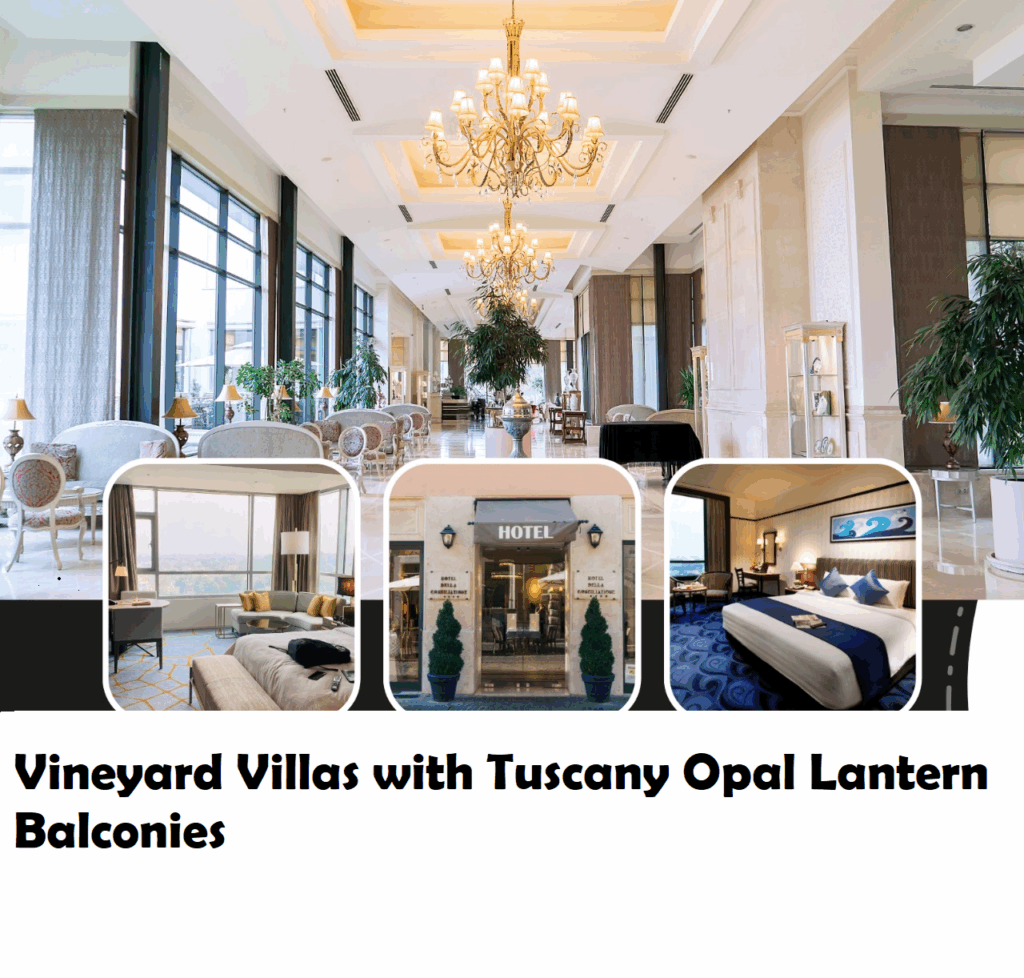
The Opal Lantern Balcony, Defined
Think of the balcony as a stage for ritual. By day, it frames green geometry—vine parcels quilted over rolling hills, masonry villages perched like crowns. By night, opal-glass lanterns soften every edge. Their milky glow turns limestone honey-warm, flatters every surface, and lends intimacy to quiet conversations and midnight tastings. The design is restrained: limewashed walls, hand-hewn beams, terracotta underfoot. A wrought-iron rail curves like script. Nothing demands attention; everything rewards it.
Signature Themes
Dawn over Sangiovese Rows
Mornings begin with a hush that vineyards do best. From your balcony, fog rises in gauzy ribbons and dissolves as the sun clears the ridge. A tray arrives—cantucci still warm, sheep’s-milk ricotta, fig jam, and a carafe of moka. You lean against the rail, lanterns cold and pearly now, and listen to the soft mechanics of the countryside: pruning shears, a distant Vespa, bells from a hilltop chapel. The day stretches—truffle walks, cellar tours, or simply pages of a novel turned slowly in a sling chair.
Truffle-Evening Loggias
As shadows lengthen, the balcony becomes a loggia for taste and scent. A truffle shaving curls over handmade tagliolini, steam carrying notes of earth and hazelnut. Glasses catch the first lantern light, garnet layers in the wine waking to pepper and cherry. Below, vineyard crews finish the last rows; above, swallows stitch the sky. The opal lanterns are dimmed to a hush—enough to illuminate smiles, never enough to compete with the stars.
Medici-Stone Terraces
Some villas inherit their bones from history: low arches, pietra serena lintels, fresco chips guarded like heirlooms. Your terrace frames this lineage without museum stiffness. Cushions in nutmeg and olive, linen throws, a niche for candles, a niche for maps. You might plan a loop through Pienza and Montalcino, or decide not to plan at all. The lanterns wait for twilight like patient ushers, ready to lift the scene once again from ordinary to timeless.
Moonlit Cantina Suites
There’s a romance to sleeping near the vineyard’s heartbeat. Suites carved near a former cantina keep a temperate hush all summer. Cedar drawers smell faintly of barrel staves, while window shutters filter silver light. Step onto the balcony after midnight: the vines are ink-black silhouettes, and the lanterns, turned low, lend the world a luminous sepia. It’s a setting that edits every worry out of the frame.
What to Expect
Service is warm rather than fussy. Breakfasts are generous and local; afternoon plates feature pecorino and honey; evenings can be as formal as a tasting menu or as simple as bruschetta grilled over olive-wood. Wellness leans elemental: a plunge pool cut into stone, outdoor tubs rimmed by lavender, yoga decks that face the valley. Sustainability shows in quiet choices—gravity-flow cellars, reclaimed timber, solar-assisted water heating, and kitchen gardens that dictate the menu more than fashion does.
Q&A with Recommendations
When is the best time to visit?
Late spring (April–June) showcases bright greens and wildflowers, while early autumn (September–October) brings harvest energy, cooler evenings, and cellars in full voice. Summer is sun-drenched and festive but warmer; winter is contemplative, perfect for firelit tastings.
Which areas feel quintessentially “vineyard villa”?
Val d’Orcia for cinematic horizons and Renaissance hill towns; Chianti Classico for iconic estates and cellar culture; Maremma if you want vineyard days and Tyrrhenian breezes.
What amenities define an opal-lantern balcony stay?
Private terraces with soft, diffused lighting; en-suite soaking tubs or outdoor showers; on-site tastings guided by the estate sommelier; farm-to-table dinners on the loggia; and concierge-led drives to nearby enotecas and artisans.
Any refined stays to consider?
- Castiglion del Bosco, Montalcino — Vineyard-ringed suites and an immersive Brunello story, from cellar to sunset terrace.
- Borgo Santo Pietro, Chiusdino — Lavish grounds, serious farm-to-table craft, and lantern-lit dining courtyards.
- Il Borro, San Giustino Valdarno — A restored village estate with cellar tours and starlit village balconies.
- Castello di Casole, Casole d’Elsa — Hilltop grandeur, cypress lanes, and terraces designed for long, candlelit evenings.
Conclusion: The Quiet Luxury of Lantern Light
Vineyard Villas with Tuscany Opal Lantern Balconies is an invitation to slow time. It’s where the day edits itself to essentials—stone, vine, light, and the people you share them with. The lanterns are more than décor; they’re a promise that each evening can be privately ceremonial, each glass of wine a small revelation. Come for the panoramas, stay for the balcony rituals, and leave with a memory that glows long after the last light is turned down. Here, exclusivity doesn’t announce itself; it flickers softly at your elbow, illuminating everything you came to Tuscany to feel.